01 · DefinitionWhat Is Biohazard Decontamination?
Biohazard decontamination is the process of addressing biological contamination, such as blood or other body fluids, so that an affected area and its contents are brought to an appropriate condition for their intended use. It combines cleaning, disinfection with suitable products used according to label directions, and removal of materials that cannot be reliably treated. It is one stage within a larger remediation project.
People often use "decontamination" to mean a very thorough clean. In practice it is a decision process as much as a cleaning process. For every surface and item in the affected zone, someone has to decide whether it can be treated in place or needs to come out.
That is why this service sits at the center of most biohazard remediation in Houston. Whether you found us by searching for emergency decontamination in Houston or were referred after another cleanup, the questions are the same: what was affected, and what can be treated?
02 · Key termsHow Do Cleaning, Disinfection, Decontamination, and Remediation Differ?
The four words describe layers, not synonyms. Each sits inside the next and depends on the one before it.
-
LAYER 01 · CLEANING
Cleaning removes what is there
Physical removal of visible soil, residue, and dried contamination. It is not meant to kill microorganisms.
-
LAYER 02 · DISINFECTION
Disinfection treats what remains
A suitable product is applied to an already-cleaned surface to reduce relevant microorganisms, following its label.
-
LAYER 03 · DECONTAMINATION
Decontamination covers the whole area
Every affected surface and item is either cleaned and disinfected or removed, so the space suits its intended use.
-
LAYER 04 · REMEDIATION
Remediation is the full project
Assessment, containment, removal, decontamination, disposal, and the repairs that follow.
Why does cleaning always come before disinfection?
Blood, dried fluids, and grime can shield microorganisms and reduce how well many disinfectants work. Spraying over soil treats the soil, not the surface beneath it.
What is contact time?
The label of an EPA-registered disinfectant states a contact time, sometimes called dwell time: how long the surface must stay visibly wet for the product to perform as described. A quick spray-and-wipe often falls short, so we keep surfaces wet for the full period and reapply where they dry early.
A spray or fog is not a substitute
Fogging a room does not remove residue, and it cannot reach contamination that has soaked into carpet pad, drywall, or foam. At most, it supplements cleaning and targeted disinfection.
03 · Surface typesWhat Surfaces Can Be Decontaminated?
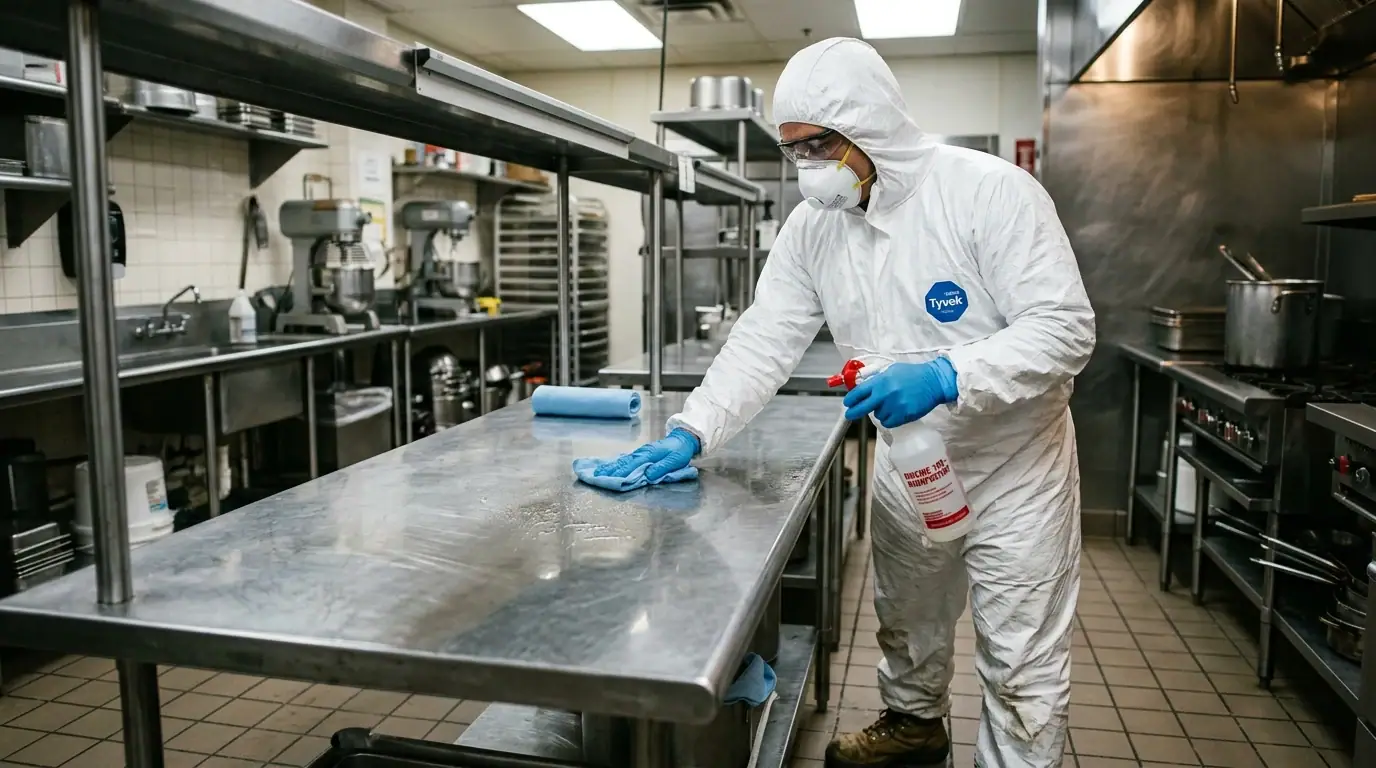
It comes down to one question: can contamination soak in? Porous materials hold it below the surface, where products applied from above may not reliably reach.
| Surface | Practical examples | What limits it | Typical result |
|---|---|---|---|
| Metal and stainless steel | Door hardware, handrails, restroom fixtures | Crevices around hinges need detailed cleaning. | Treat in place |
| Sealed stone, tile, glass | Countertops, shower walls, mirrors | Grout and caulk lines absorb. | Treat in place |
| Hard plastic and laminate | Desks, cabinet faces, light switches | Lifted edges can trap fluid. | Treat in place |
| Painted walls and trim | Hallway walls, baseboards, door frames | Paint must be intact. | Case by case |
| Unsealed wood and concrete | Subfloor, framing, garage slabs | Absorbent; may be sealed or cut out. | Case by case |
| Soft furnishings | Carpet pad, mattresses, cushion foam | Saturation can't be reliably reached. | Usually removed |
Mixed-material items are the hardest calls. An office chair may have a plastic base that treats easily and a foam seat that does not, so we assess each component separately.
04 · Related workWhere Does Decontamination Fit With Other Cleanup Work?
Decontamination is rarely requested on its own. It is usually the central stage of a larger job, or a follow-up to one.
-
SITUATION 01
After a blood or fluid spill
Once professional blood cleanup removes gross contamination, nearby surfaces still need disinfection.
-
SITUATION 02
After a scene is released
Decontamination makes up much of the crime scene remediation that follows. We never investigate or collect evidence.
-
SITUATION 03
After an accident or injury
Incidents handled by our trauma cleanup service can affect floors, equipment, and shared areas at once.
-
SITUATION 04
Inside a car or truck
Tight cabins with layered materials are handled through vehicle decontamination instead of a room-based plan.
05 · ProcessHow Does the Decontamination Process Work?
The sequence follows one principle: contamination should only move in one direction, from the affected zone out to packaged waste.
-
Map the affected zone
We find every surface and item contamination reached, including edges, undersides, and walking paths.
-
Set up work zones
An affected zone, a transition zone for removing protective equipment, and protected clean areas.
-
Take out what cannot be treated
Saturated porous materials come out first, so they cannot drip onto surfaces already treated.
-
Clean, then disinfect to the label
Surfaces are cleaned from high to low, then an EPA-registered disinfectant is applied according to label directions for the full contact time.
-
Clear the transition zone
Tools and the transition area are cleaned, and waste goes out for disposal according to the material and the rules that apply to it.
-
Review and record
We walk the area with you, checking visually and for odor, and explain what was treated, what was removed, and what rebuilding should follow.
About testing
A visual review is not laboratory proof. Some situations, such as certain commercial settings or insurer requests, may call for independent testing, which we can discuss before work begins.
06 · ContentsCan Contaminated Contents Be Treated?
Often, yes. Belongings follow the same porous and non-porous logic as the room around them.
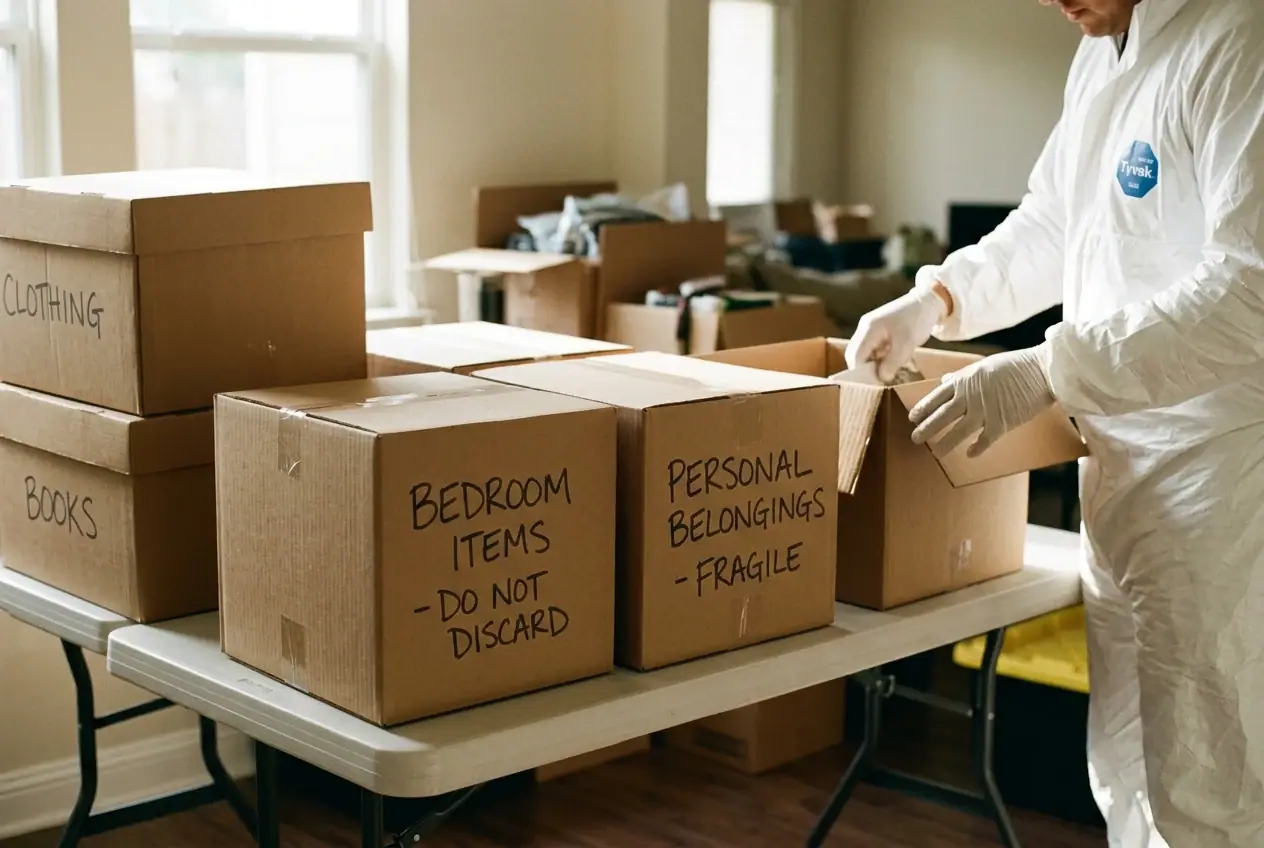
- Hard goods such as dishes, tools, glass, and sealed plastics can usually be cleaned and disinfected.
- Textiles with light contact may be launderable. Saturated items usually are not.
- Paper and photographs absorb fluids and are hard to disinfect. We can photograph them for your records first.
- Electronics can have casings wiped, but contamination inside vents or keyboards usually rules them out.
Removed items are listed so you, and your insurer if you file a claim, have a clear record.
07 · SafetyWhat Should You Do Before Decontamination, and What Should You Avoid?
Until the area is assessed, the most useful thing you can do is keep the affected zone from growing.
Before we arrive
- Close off the affected area, and keep children and pets out.
- Leave items where they are, even if they look out of place.
- Note which rooms and belongings you know were affected.
- Seek medical advice if anyone had skin or eye contact with body fluids.
Please avoid
- Spraying disinfectant over contamination that hasn't been cleaned.
- Mixing bleach with other products.
- Carrying contaminated items through clean rooms.
- Using a household vacuum or steam cleaner in the area.
08 · Local factorsWhich Houston Conditions Affect Decontamination?
A few local conditions change how long materials stay damp and how far contamination can travel.
- Surfaces dry slowlyHumidity lengthens drying times, which affects odor and when a treated room can go back into use.
- Materials may already be compromisedAfter storms or past water intrusion, subfloor or drywall may be damaged before any biohazard occurs.
- Air conditioning runs most of the yearReturn vents near an affected room can pull odor through a building, so we check how air moves around the zone.
- Shared buildingsHallways, elevators, and shared restrooms may sit on the affected path and need coordination with management.
09 · Pricing factorsWhat Determines the Cost of Decontamination?
Decontamination is priced on scope, not square footage. A small room with several material types can take longer than a large room with hard floors only. The main variables:
- Size of the affected zone
- Number of material types
- Porous material removal
- Contents to sort and treat
- Shared or high-touch areas
- Access and building rules
- Odor treatment
- Waste volume and disposal
- Follow-up after earlier cleanup
We explain the expected scope before starting. Coverage varies by policy, so ask your insurer whether any of the cost may be covered.
10 · QuestionsBiohazard Decontamination Questions
What is biohazard decontamination, in simple terms?
It is the work of making an area affected by biological contamination appropriate to use again: cleaning, proper disinfection, and removal of what cannot be treated reliably.
What is the difference between cleaning and decontamination?
Cleaning is one step: removing visible soil and residue. Decontamination adds disinfection and decisions about materials that must come out. A room can look clean and still not be decontaminated.
What surfaces can be decontaminated in place?
Intact, non-porous surfaces such as metal, glass, sealed stone, and hard plastic usually can. Painted surfaces depend on their condition. Saturated carpet pad and cushion foam are usually removed.
Can belongings from the affected room be treated?
Many can. Hard items are usually cleaned and disinfected, while fabrics, paper, and electronics are assessed one by one. Nothing personal is discarded without talking with you first.
When should professional decontamination be considered instead of regular cleaning?
Consider it when body fluids spread beyond a small spot, reached porous materials, or affect a space others will use, or when an area looks clean but you don't know whether it was disinfected. Describe what happened and we can tell you whether more work is likely needed.