
01 · DefinitionWhat Is Unattended Death Cleanup?
Unattended death cleanup is the remediation of a home or unit where someone passed away and was not found for some time. After the medical examiner releases the property, technicians remove decomposition-affected materials, clean and disinfect the exposed structure, address odor at its source, and evaluate furniture and belongings so the space can be repaired and used again.
These situations are usually discovered by a neighbor, a building manager, or a relative who hasn't heard from someone in a while. By then, the people left to make decisions are often dealing with shock, distance, and an unfamiliar property all at once.
Our role starts after the authorities have finished. We don't determine what happened or why. We focus on the property itself and treat the person's home and belongings with respect.
Decomposition cleanup differs from a spill because fluids move slowly downward over time, through bedding or upholstery into flooring and sometimes the subfloor.
02 · Houston factorsHow Do Heat, Humidity, and Time Change the Scope?
Two things shape almost every unattended death remediation: how long passed before discovery, and the conditions inside the property.
- Heat speeds the processA home without working air conditioning can get very hot during a Houston summer, and warmth accelerates decomposition and odor.
- Humidity keeps materials dampMoist air slows drying in carpet pad, wood, and drywall, which lets odor settle deeper and can support mold growth in affected areas.
- The HVAC system moves airIf the system was running, odor may have been carried through return vents and ductwork into other rooms.
- Slab or pier-and-beamNewer houses usually sit on a concrete slab, while some older Houston homes have raised wood floors. The foundation type changes where fluids can travel.
Apartments and shared walls
In multi-unit buildings, odor can reach hallways and neighboring units. We coordinate with management to keep the work contained and limit disruption.
03 · ProcessHow Is Decomposition Contamination Handled?
The work moves from the source outward, so odor is never treated while its cause remains.
-
Confirm release and arrange access
We check that the medical examiner or authorities have released the property and agree on access with the family, executor, or manager.
-
Map the affected area
Technicians trace contamination through flooring layers, along walls, into furniture, and toward vents, and record what they find.
-
Contain and protect
The work zone is separated from the rest of the property, air returns in the area are covered, and protective equipment is worn throughout.
-
Remove saturated materials
Bedding, furniture, carpet, pad, and flooring that absorbed fluids are taken out in sections and sealed for disposal.
-
Clean and disinfect the structure
Exposed subfloor, slab, framing, and nearby surfaces are cleaned, then disinfected with products applied according to label directions.
-
Treat remaining odor
Once the source is gone, odor in the air and building materials is addressed. Some subfloors may be sealed before new flooring goes in.
-
Walkthrough and records
We review the finished area with whoever is responsible for the property and provide notes on removed items and repairs still needed.
04 · Flooring & subfloorWhat Happens to Contaminated Flooring?
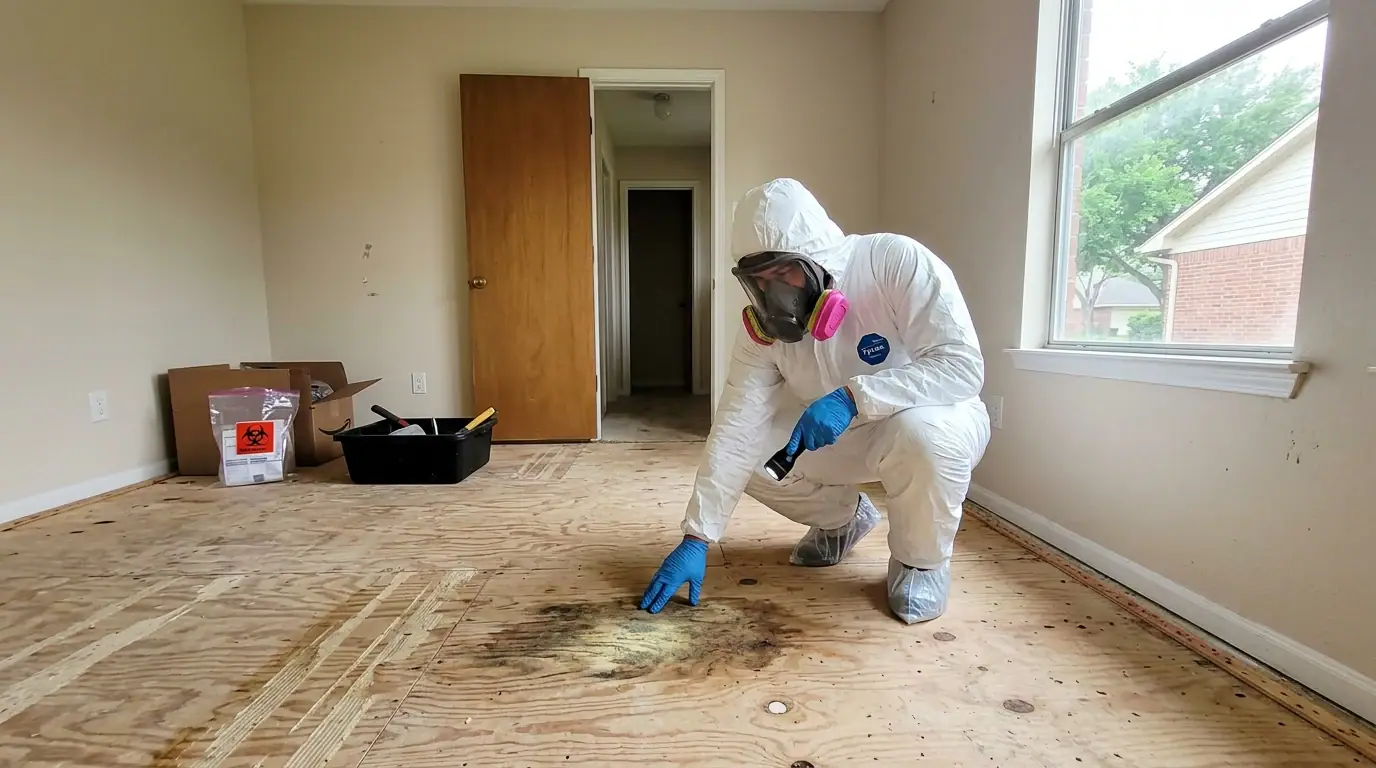
Flooring is where most of the work happens in an unattended death. The finish on top often looks salvageable while the layer beneath it is not, so we evaluate each layer separately.
| Floor layer | Why it matters | Typical outcome |
|---|---|---|
| Carpet and pad | Fluids pass straight through to the tack strip and the surface below. | Removed |
| Laminate and floating floors | Liquid spreads beneath the planks, well past the visible area. | Often removed |
| Hardwood | Fluids work into gaps between boards and into the wood itself. | Case by case |
| Ceramic tile | Tile resists absorption, but grout and cracked tiles may not. | Case by case |
| Wood subfloor | Plywood and older plank subfloors can absorb fluids and hold odor. | Cut out or sealed |
| Concrete slab | Porous concrete can retain residue that affects new flooring. | Clean & seal |
Where a wood subfloor is removed, a contractor typically replaces it before new flooring goes down. We tell you which repairs to plan for.
05 · Odor remediationCan the Odor Be Removed?
In most cases, yes, but only after the source is gone. Decomposition odor clings to porous materials, so sprays and fragrances only hide it for a short time. These signs suggest odor has spread beyond the immediate area:
- Odor in adjoining rooms or closets. Soft furnishings and stored clothing tend to absorb it.
- Odor from vents when the system runs. Return ducts and the air handler may need attention.
- Odor that returns on humid days. This often points to material still holding residue.
- Neighbors notice it in a shared hallway. Air may be moving through gaps around doors or shared walls.
After affected materials are removed and surfaces treated, we address residual odor in the space. Odor treatment is one part of broader biohazard decontamination, which covers the rooms and contents around the source.
06 · Furniture & contentsAre Furniture and Belongings Evaluated?
Yes. Everything in the affected area is reviewed before removal. What can be kept depends on the material and its distance from the source.
-
CONTENTS 01
Beds and upholstered furniture
Pieces in direct contact are usually disposed of. Items further away may only need cleaning and odor treatment.
-
CONTENTS 02
Clothing and textiles
Fabrics in other rooms can often be laundered or treated, while those near the source generally cannot.
-
CONTENTS 03
Papers, photos, valuables
Wallets, IDs, financial papers, jewelry, and photographs are set aside for the family or executor.
-
CONTENTS 04
Electronics and appliances
Hard-cased items can often be cleaned. Anything with contaminated vents or fabric parts is assessed individually.
How are removed materials disposed of?
Affected materials are bagged, sealed, and routed for disposal based on the material and the requirements that apply. Items that were never affected, such as furniture in other rooms, are left for the estate to decide on.
07 · Before cleanupWhat Should You Do While You Wait for Cleanup?
Whether you are family, an executor, or a manager, the aim is to keep the area closed and avoid spreading contamination or odor.
Do
- Keep the door to the affected room closed.
- Keep children, pets, and visitors out of the property.
- Ask us before changing thermostat or HVAC settings.
- Photograph unaffected rooms for insurance if you feel able to.
- Contact the insurer, the landlord, or the estate attorney, as applicable.
Don't
- Don't enter the affected room without protective equipment.
- Don't let maintenance staff start pulling up flooring.
- Don't cover odor with air fresheners, candles, or rented odor machines.
- Don't haul furniture or bedding to the curb or a dumpster.
- Don't open windows to other units or shared hallways.
08 · Who we work withWho Usually Arranges Death Cleanup in Houston?
Next of kin and estate executors
Relatives are often handling the estate from out of town. Tell us how access and updates should work, and we will set documents and valuables aside. You don't need to visit for the work to go ahead.
Landlords and apartment managers
For rental properties, the priority is usually containing odor, protecting neighboring units, and readying the space for repairs. We coordinate timing with on-site staff and record what was removed and what remains.
If there was also a significant amount of blood, our professional blood cleanup service covers those surfaces in the same visit.
09 · Pricing factorsWhat Affects the Cost of Unattended Death Cleanup?
We don't quote a standard price, because the time before discovery, the indoor conditions, and the flooring beneath all change the scope. The main variables are:
- Time before discovery
- Indoor temperature
- Flooring and subfloor removal
- Furniture and bedding
- Contents to sort
- Odor in other rooms or ductwork
- Multi-unit coordination
- Disposal volume
After the assessment, we explain the scope and the reasons behind it. Some homeowner's policies cover this work, depending on the terms, so ask the insurer early.
10 · QuestionsUnattended Death Cleanup FAQs
Does the medical examiner or the police clean the property?
No. Their work ends when the property is released. Cleanup then becomes the responsibility of the owner, the estate, or the landlord, depending on the situation.
How is this different from cleaning up a blood spill?
Decomposition affects a wider area over a longer period. It usually reaches deeper into flooring and furniture, and it produces odor that can spread through the property, so more material removal and odor work are involved.
Will the odor come back after cleanup?
Odor tends to return when affected material is left behind. That is why removal comes first. If a trace remains at the final walkthrough, we look for the remaining source rather than masking it.
Does all the flooring in the room have to be replaced?
Not always. Removal usually focuses on the affected section and a margin around it. The final extent depends on the flooring type and how far fluids traveled underneath.
Can the family go through belongings before you start?
We recommend waiting until the area has been assessed. We'll set aside anything of value from the affected room for you to review. For incidents involving injury as well, see our trauma remediation page.