
01 · OverviewWhat Is Homicide Cleanup?
Homicide cleanup is the remediation of blood, body fluids, and other biological contamination at a property after a violent death, once authorities have released it. It includes mapping how far contamination traveled, removing materials that cannot be treated, cleaning and disinfecting what remains, and handling the person's belongings with care. It has no part in the investigation.
It is a narrower and more personal job than general crime scene remediation. Contamination is often heavier, it may extend across several rooms, and the people arranging the work are frequently close to the person who died.
That changes how the work is planned. Pace, privacy, and communication matter as much as technique, and decisions about furniture, clothing, and keepsakes are made with the family rather than for them.
02 · Who arranges itWho Usually Arranges Homicide Scene Cleanup?
Responsibility normally falls to whoever controls the property, and each group tends to bring different questions.
-
CLIENT 01
Families and next of kin
Often handling grief, funeral plans, and legal matters at once. They need the cleanup taken off their list, with check-ins about personal items.
-
CLIENT 02
Executors and estate representatives
May be settling a property from out of town and need a written record of what was removed, cleaned, and left for repair.
-
CLIENT 03
Landlords and property managers
Must protect neighboring units and common areas, speak carefully with other tenants, and prepare the unit for repairs.
-
CLIENT 04
Business owners
Need the affected area remediated before staff return, with thought given to shared spaces and how the incident is discussed at work.
If a death or serious injury was accidental rather than violent, the work is usually handled as trauma scene cleanup, which uses a similar method with different considerations.
03 · ExtentWhy Does Contamination Often Reach Beyond One Room?
Violent incidents are rarely confined to one spot, and the hours afterward add more movement. These are the usual reasons the affected area turns out larger than it first appears:
- Movement during the incident. People may have moved between rooms, leaving traces on floors, walls, and door frames along the way.
- Emergency response and investigation. Responders and investigators have to move through the property, which can carry contamination along hallways and onto entry flooring.
- Absorption below the surface. Carpet, rugs, and floorboard gaps let fluids reach pad, subfloor, or slab where no one can see them.
- Nearby belongings. Bedding, clothing, papers, and electronics close to the area may be affected even when they look untouched.
04 · ProcessHow Is a Homicide Scene Remediated, Step by Step?
The sequence serves two goals: addressing contamination thoroughly in every affected area, and leaving the family in control of what happens to belongings.
-
A conversation before any visit
We ask what you are comfortable sharing, who holds keys, whether the property has been released, and which items you already know you want kept.
-
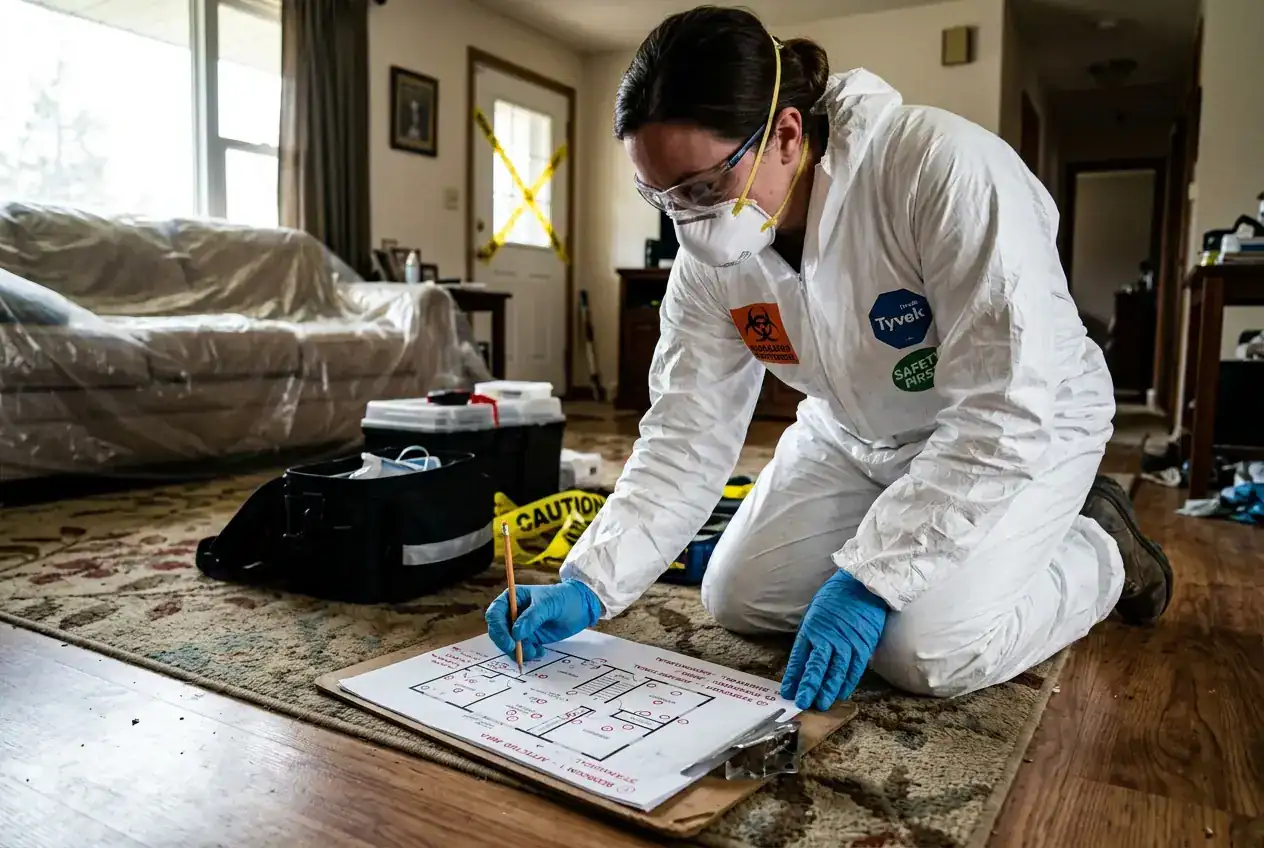
Room-by-room mapping
Technicians trace contamination through each room and pathway and record which surfaces, materials, and contents are involved.
-
Setting aside what matters
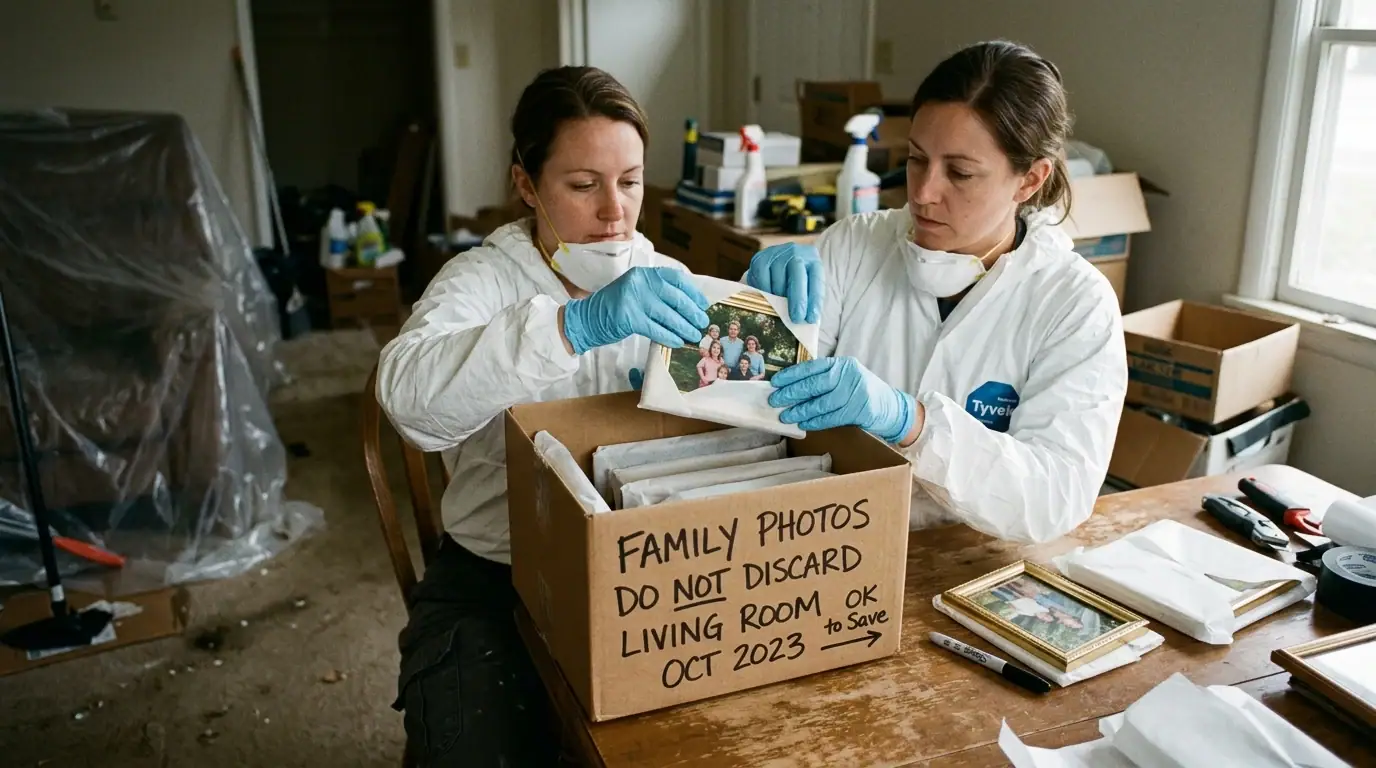
Photographs, documents, and other personal items outside the affected zone are moved to a clean area before removal work starts.
-
Containment and removal
Affected rooms are sealed from the rest of the property. Saturated flooring, drywall, and furnishings that cannot be recovered are removed and packaged.
-
Cleaning and disinfection
Each surface that stays is cleaned of residue and then disinfected, following the product label for coverage and contact time.
-
Odor check and handover
We check for lingering odor, confirm every mapped area has been addressed, and hand over a record of the work for the family, estate, or insurer.
05 · Property contentsWhat Happens to Furniture, Clothing, and Keepsakes?
Contents are often the hardest part for families, so each category is discussed before anything leaves the property. The final decision is made on site, with you.
| Item | How it is usually approached | Typical outcome |
|---|---|---|
| Photos and documents | Items outside the affected area are packed and returned. Contaminated paper is hard to treat and is discussed individually. | Discussed with you |
| Clothing and linens | Garments with contact are usually discarded. Unaffected items stored nearby are packed separately. | Case by case |
| Upholstery and mattresses | Fluid absorbed into foam or padding generally cannot be reliably decontaminated. | Often removed |
| Hard furniture | Sealed wood, metal, and glass can usually be cleaned; cracked or unsealed finishes get a closer look. | Often cleaned |
| Jewelry and hard keepsakes | Non-porous metal and stone items can often be cleaned and returned to the family. | Often returned |
If family members would rather not take part in sorting, a trusted representative can make those decisions on their behalf.
06 · Affected materialsWhich Building Materials May Need Removal?
Beyond contents, the room itself often needs work, and flooring is usually the largest part of it.
Flooring and subfloor
Carpet and pad in the affected area are usually removed. Where fluids passed through, the slab or wooden subfloor is cleaned and may be sealed before new flooring goes in. Hardwood seams and laminate joints are checked for seepage underneath.
Walls, trim, and doors
Sealed paint and trim can often be cleaned. Drywall that absorbed contamination, and baseboards with fluid behind them, are cut out and noted for repair.
Our page on professional blood cleanup explains in more depth how individual materials respond. Where a room needs further treatment after removal, our biohazard decontamination service covers that final stage.
07 · Before cleanupWhat Should Families and Property Owners Do Before Cleanup?
You do not need to go back inside to prepare. Most of what helps can be done by phone.
Do
- Confirm with investigators that the property has been released for cleanup.
- Keep relatives, tenants, and staff out of the affected rooms.
- Tell us which items you want kept, even if you're unsure they can be saved.
- Contact the property's insurer, and the landlord if the home is rented.
Don't
- Don't attempt to clean any part of the scene yourself.
- Don't let well-meaning friends or neighbors start cleaning.
- Don't remove belongings from affected rooms before they are assessed.
- Don't open windows and run fans to clear odor, which can spread it.
You set the pace
Some families want an update at every step; others prefer one call when the work is finished. Tell us which suits you, and a trusted person can handle access if you would rather not be there.
08 · Local factorsHow Do Houston Properties Shape Homicide Cleanup?
Local building types and climate change how far contamination can travel and what it takes to return a property to use.
- Pier-and-beam homesSome older Houston neighborhoods have raised, wood-framed floors. Fluid that passes through floorboards can reach joists and the crawl space, which widens the assessment.
- Shared walls and corridorsIn apartments, townhomes, and condominiums, the neighboring unit and shared hallway may need checking, and neighbors' privacy needs protecting too.
- Closed homes and air conditioningA home shut up in summer develops odor quickly, and a running HVAC system can carry it to other rooms, so the air-handling side is considered during assessment.
- Families arranging from afarRelatives living outside the Houston area can discuss the scope by phone before traveling, and a representative can provide access.
09 · Pricing factorsWhat Affects the Cost of Homicide Cleanup?
Each homicide cleanup is quoted from its own scope, so we don't publish prices. The factors that carry the most weight are:
- Number of affected rooms
- How far fluids migrated
- Subfloor or crawl-space work
- Furniture and mattress removal
- Belongings to sort, pack, or document
- Drywall and trim removal
- Odor treatment
- How long the property sat closed
- Waste packaging and disposal
Homeowner's and landlord policies sometimes cover this kind of cleanup, depending on the wording and circumstances. For an estate, the executor usually coordinates with the insurer, and a written scope from us can support that conversation.
10 · QuestionsQuestions About Homicide Cleanup
What happens during homicide cleanup?
In short: assessment, containment, removal of materials that cannot be saved, cleaning and disinfection of what remains, and a final check with a record of the work. Belongings are sorted with the family's input throughout.
Can blood and body fluids be removed?
From sealed, hard surfaces, generally yes. For absorbent materials like carpet pad, mattresses, and cushion foam, the dependable answer is usually removing the affected material. The slab or subfloor beneath is then cleaned and treated before repairs.
When can remediation begin?
Once the investigating agency has released the property for cleanup. We cannot shorten that timeline or enter early. After release, earlier remediation is generally easier, because contamination has had less time to spread and odor less time to build.
Does cleanup include affected contents?
Yes. Furniture, clothing, papers, electronics, and keepsakes in or near the affected area are assessed as part of the job. Some can be cleaned and returned; nothing personal is discarded until you or your representative agree.
Is crime-scene investigation part of the service?
No. We play no part in any investigation, and we do not collect evidence, reconstruct events, or comment on how a death occurred. Our work starts after authorities have finished and released the property.