
01 · DefinitionWhat Is Tear Gas Cleanup?
Tear gas cleanup is the removal of irritant residue left indoors after tear gas, pepper spray, or a similar chemical irritant has been released. The work physically removes particles and oily residue from surfaces, fabrics, contents, and air pathways, and sorts porous items into those that can be cleaned and those better discarded. It is residue removal, not a chemical treatment.
"Tear gas" is a loose term. It usually refers to CS, a compound dispersed as a fine powder or aerosol, while pepper spray relies on OC (oleoresin capsicum), an oily pepper extract. Once settled, neither is really a gas. Both leave residue that can irritate eyes, skin, and airways again when touched or stirred up.
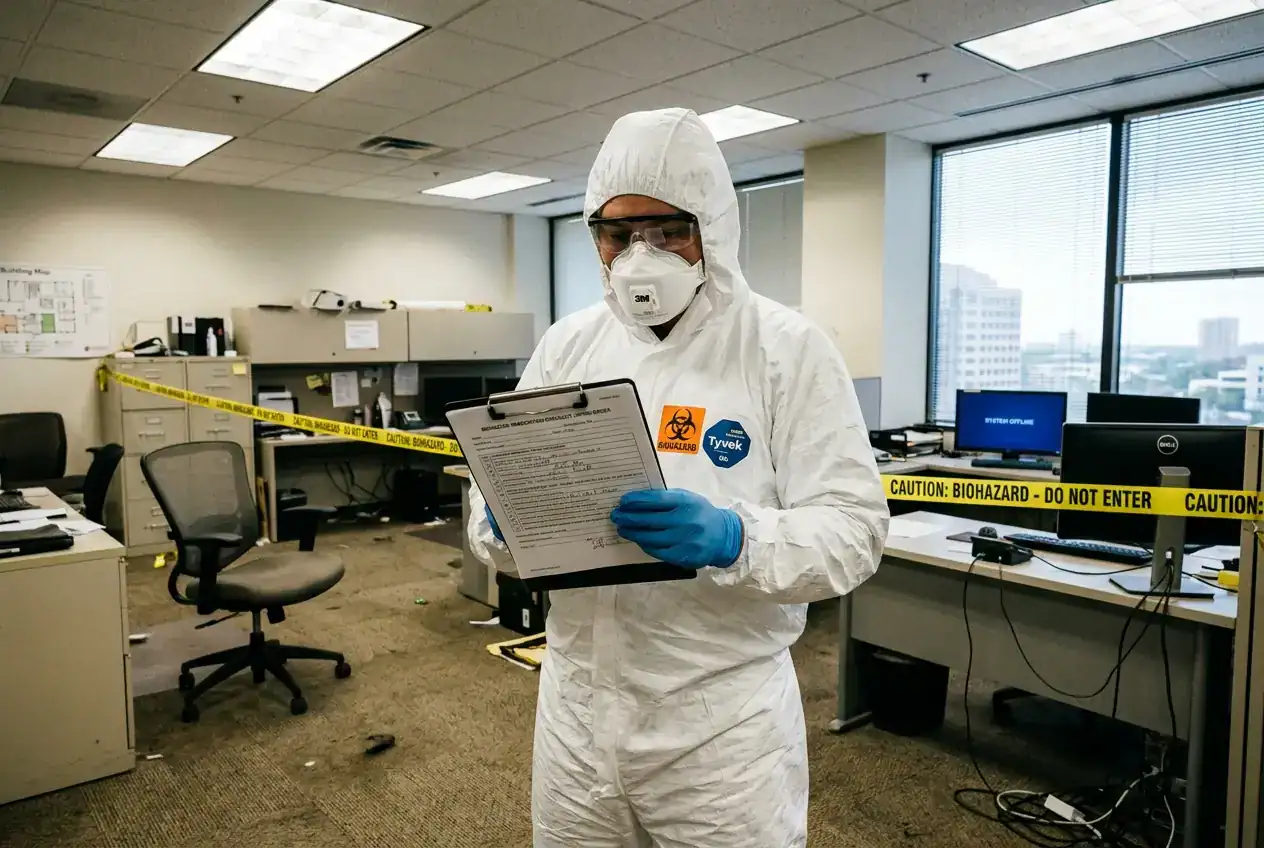
It is a chemical irritant rather than biological contamination, yet the cleanup follows the same discipline as biohazard decontamination: contain the area, remove residue, work surface by surface, and make deliberate decisions about porous items.
02 · First stepsWhat Should You Do After Tear Gas Contamination?
A few early decisions limit how far residue spreads and make the cleanup simpler.
What to do
- Seek medical advice for anyone with symptoms. Call 911 for serious breathing difficulty.
- Keep children, pets, and anyone with asthma out of affected rooms.
- Leave the HVAC, ceiling fans, and portable fans off.
- If it is safe to do quickly, open exterior windows in affected rooms, then leave.
- Keep clothing worn during exposure apart from other laundry.
What not to do
- Don't vacuum, sweep, or dry-dust. It lifts particles back into the air.
- Don't try to "neutralize" residue with bleach, solvents, or mixed chemicals.
- Don't sleep in or use an affected room before it is cleaned.
- Don't eat food that was left open in the area.
- Don't rub your eyes after touching affected surfaces.
Skip the online chemical recipes
Advice to mix household products to "break down" tear gas is risky. Combined cleaners can release dangerous fumes, and harsh products can damage finishes while leaving residue behind.
03 · Common situationsWhen Is Tear Gas Cleanup Needed?
Most requests come from owners and tenants dealing with the aftermath of an event they had no part in.
-
CASE 01
After law-enforcement use
Irritants are sometimes used in or around a home or business during an incident. Once the property is returned, the owner is often left to arrange cleanup. We handle the cleanup only.
-
CASE 02
Pepper spray discharged indoors
A self-defense spray can go off by accident in an apartment, office, or store. Even a short burst can affect a whole room and the air system serving it.
-
CASE 03
Residue drawn in from outside
When irritants are used near a building, residue can enter through doors, windows, and fresh-air intakes and settle in entryways and ground-floor rooms.
-
CASE 04
Spray inside a vehicle
Small, fabric-filled cabins concentrate residue quickly. Our cleanup for vehicle interiors explains how enclosed cabins are handled.
04 · Warning signsCan Tear Gas Residue Remain on Surfaces?
Yes. Residue does not simply air out of a closed building. Particles stay until removed, and oily pepper-spray residue binds to fabric. Common signs it is still present:
- Eyes or nose sting when you walk in. Residue on surfaces and soft furnishings keeps irritating long after the event.
- Irritation flares when you sit or lie down. Cushions and mattresses release particles when compressed.
- Symptoms return when the air system starts. A contaminated filter or return can recirculate residue.
- Handling belongings leaves skin tingling. Remotes, toys, and clothing may still carry residue.
05 · Air handlingWhy Should the HVAC Stay Off Until It's Assessed?
A central system pulls air from rooms through a return, across a filter and coil, and back out through the ducts. After tear gas use, it can collect residue in one room and deliver it to others.
During assessment we check the returns and supply registers near the affected area, the filter, and whether the system ran after the incident. Registers in the work area are covered during cleanup, and the filter is usually replaced at the end.
When ductwork needs attention
If the system ran for a while afterward, residue may have reached ducts and equipment beyond surface cleanup. We'll explain what we found and what to raise with a qualified HVAC contractor before normal use resumes.
06 · ProcessHow Does Tear Gas Residue Removal Work?
The aim is to lift residue off surfaces and out of the building without pushing it into the air or into clean rooms.
-
Assess with the air system off
We find where residue settled, which rooms and contents were exposed, and whether the HVAC ran afterward.
-
Protect unaffected spaces
Doorways are sealed off, floor paths protected, and registers in the work area covered.
-
Capture loose particles
Settled powder is typically collected with HEPA-filtered vacuuming and careful wiping rather than sweeping or blowing.
-
Wash surfaces in stages
Walls, ceilings, floors, fixtures, and furniture are cleaned top to bottom with appropriate solutions, often in several passes.
-
Sort contents with you
Belongings are grouped into items to clean, items to assess further, and items better discarded.
-
Check for lingering irritation
Rooms are reviewed for residue and irritation, and any follow-up is explained.
07 · Affected materialsWhich Materials and Contents Can Be Cleaned?
Hard, sealed surfaces usually respond well to repeated cleaning. Soft and porous materials are harder, and the answer depends on how heavily they were exposed.
| Material | How residue behaves | Typical outcome |
|---|---|---|
| Hard floors, counters, glass | Powder sits on top and lifts with vacuuming and repeated washing. | Clean in place |
| Painted walls and ceilings | A film builds on textured paint. Heavy exposure may mean repainting. | Case by case |
| Carpet and rugs | Particles work into pile and backing. Light exposure may respond to extraction. | Case by case |
| Upholstery and mattresses | Foam holds residue and releases it under pressure. | Often removed |
| Clothing, bedding, curtains | Fabric absorbs oily residue. Some items recover with repeated laundering. | Case by case |
| Open food | Residue can settle on or into unsealed food and packaging. | Discard |
Items that deserve extra care
Children's toys, pet bedding, and pillows are held to a stricter standard. Electronics can have their exteriors wiped, but residue inside vents may need a specialist. If an item matters to you, we'll say honestly whether it can be cleaned.
08 · Local factorsWhy Does Houston's Climate Matter for Tear Gas Residue?
Local climate and building habits change how residue behaves indoors.
- Humidity helps residue clingMoist air can help powder and oily residue adhere to fabrics and textured surfaces, so dry removal alone is often not enough.
- Buildings stay sealed for coolingHomes and offices are kept closed most of the year, so residue has few ways out and stays where it lands.
- The AC is hard to leave offIn hot months, switching the system back on is tempting, but it is the quickest way to spread residue.
- Hot, closed vehiclesDrivers tend to start the air conditioning right away, drawing cabin residue through the vents.
09 · Pricing factorsHow Is Tear Gas Cleanup Priced?
One room after a pepper-spray burst and a building where irritant reached several floors are very different projects. Pricing follows the actual scope:
- Number of affected rooms
- Type and amount of irritant
- Whether the HVAC ran afterward
- Ceiling height and wall area
- Carpet and upholstery
- Contents to sort and clean
- Items needing disposal
- Repeat cleaning passes
We outline the likely scope before work starts. Some property policies respond to certain events, so ask your insurer what applies.
10 · Our approachWhat Can You Expect From Us?
- No neutralization claimsWe remove residue physically and say so plainly.
- Clear limitsIf something is beyond surface cleanup, we tell you.
- Care with belongingsNothing personal goes without a conversation.
- A neutral presenceWe focus on the property, not the incident.
11 · QuestionsTear Gas Cleanup FAQs
What should I do right after tear gas gets into my home or business?
Get people out of the affected area, seek medical advice for anyone with symptoms, and keep the HVAC and fans off. Close doors to affected rooms, avoid vacuuming or sweeping, and arrange an assessment.
Can tear gas residue stay on surfaces after the air clears?
Yes. The airborne cloud settles, but residue stays on floors, furniture, fabrics, and filters, and it can keep irritating people when disturbed.
Can belongings exposed to tear gas be cleaned?
Many hard items can, with repeated washing. Soft goods depend on exposure. Some clothing and linens recover, while mattresses, cushions, and heavily exposed upholstery often aren't worth the risk of ongoing irritation.
Does tear gas cleanup deal with odor and residue?
The cleanup targets the residue itself, and removing it is what reduces the lingering smell and irritation. We check rooms at the end and tell you if any area or item needs more attention.
Should I try to clean tear gas residue myself with chemicals?
We don't recommend it. Mixing products can create hazardous fumes, and aggressive cleaners can damage surfaces without removing the residue. If you're unsure how far it has spread, an assessment is the safer route.